
 1Google
 2UC Santa Barbara
 3UC Santa Cruz
 4Stanford University
 5University of Oxford
 6Emory University
 7Columbia University
Why proactive assistance is hard
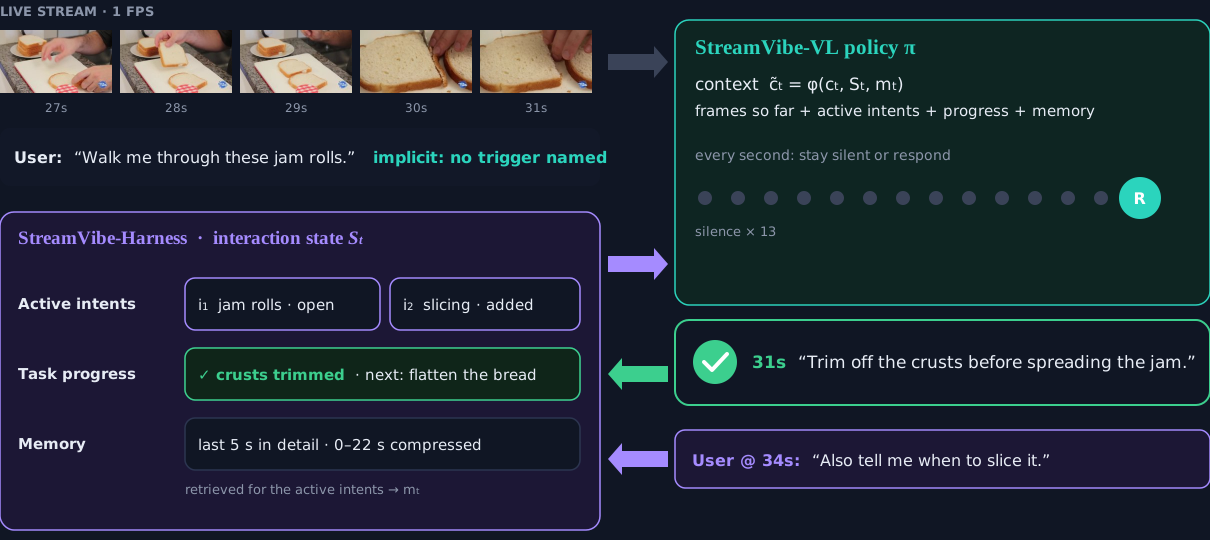
Today’s streaming assistants wait for a request that names the event to watch for. Real users state goals and change them as they go.
The intent is often implicit
“Help me when I get stuck” names no trigger; the assistant must decide when to help.
The task state keeps changing
Without tracking progress, assistants repeat, give outdated advice, or miss steps.
Requests are revised mid-task
Users add, replace or interrupt requests; assistants keep following the first one.
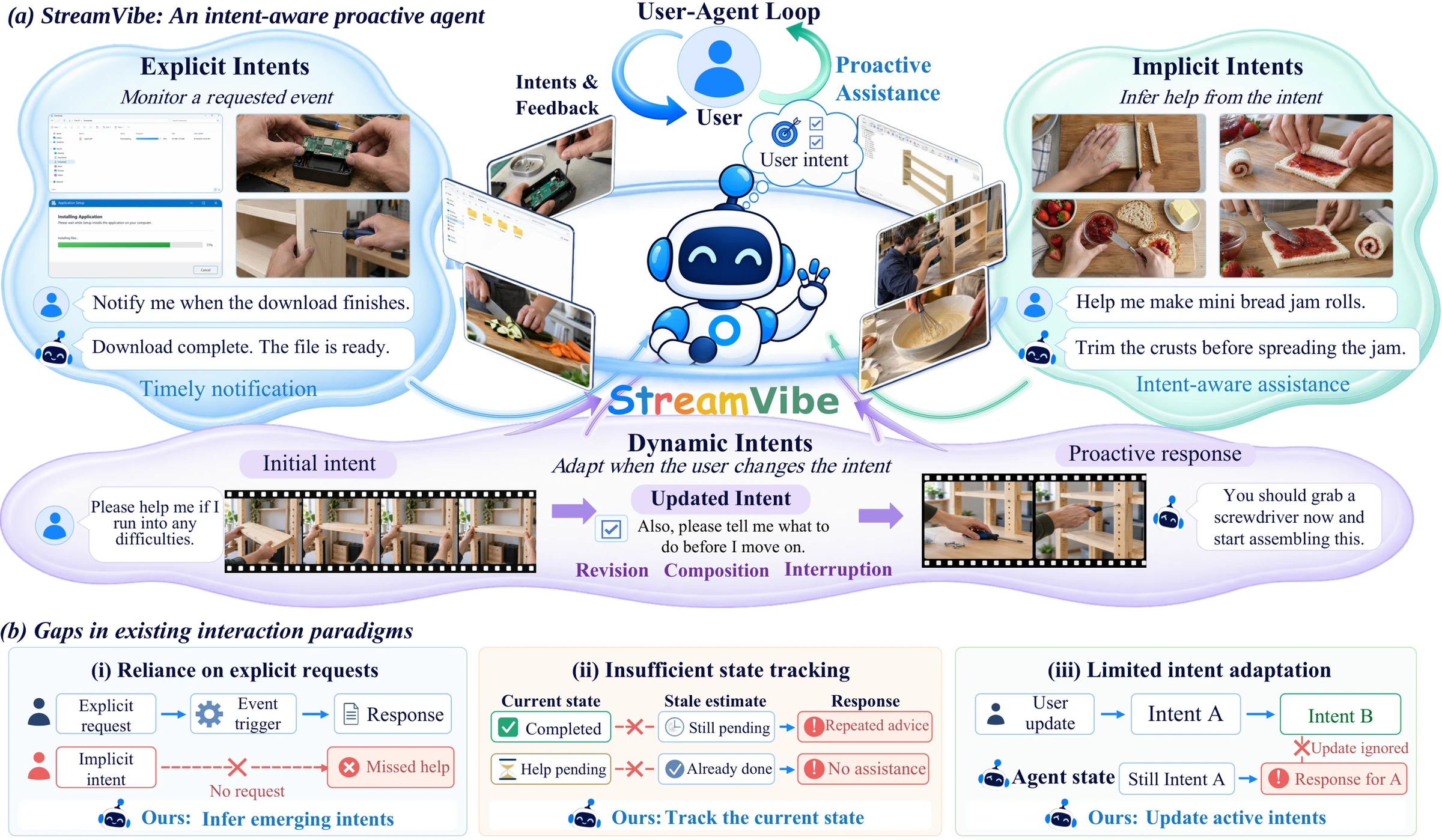
Three levels of user intent
Graded by how explicit the intent is and whether it changes mid-task.
The user names a condition or event; the assistant responds when it occurs.
The user gives a goal; the assistant infers when and how to help from the video and task progress.
The request is revised, extended or interrupted while the task is under way.
StreamVibe on real streams
Twenty benchmark clips. Hover to preview, click to play with StreamVibe-VL’s replies and five baselines.
Benchmark construction and evaluation
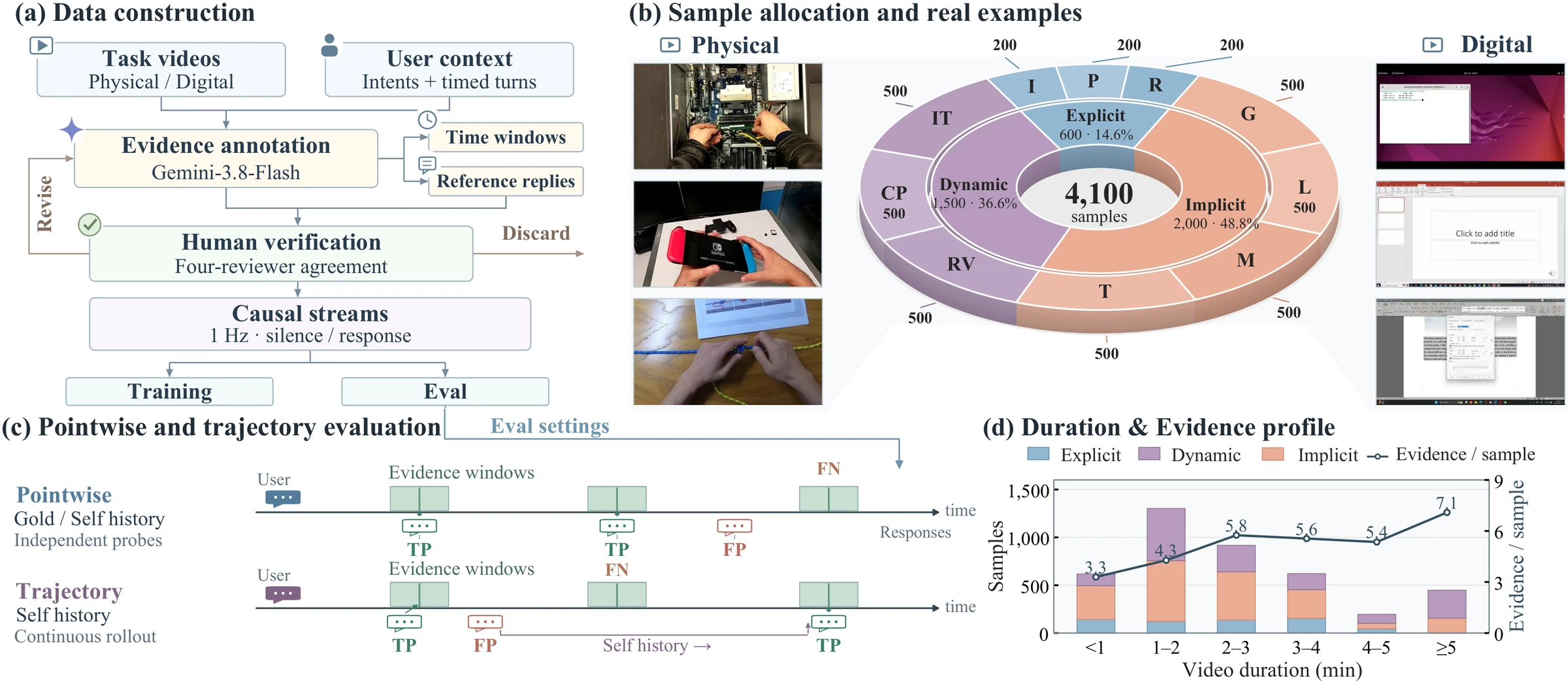
Physical and digital task videos. Gemini-3.8-Flash proposes help points with time windows and reference replies; a sample is kept only if four reviewers all approve it.
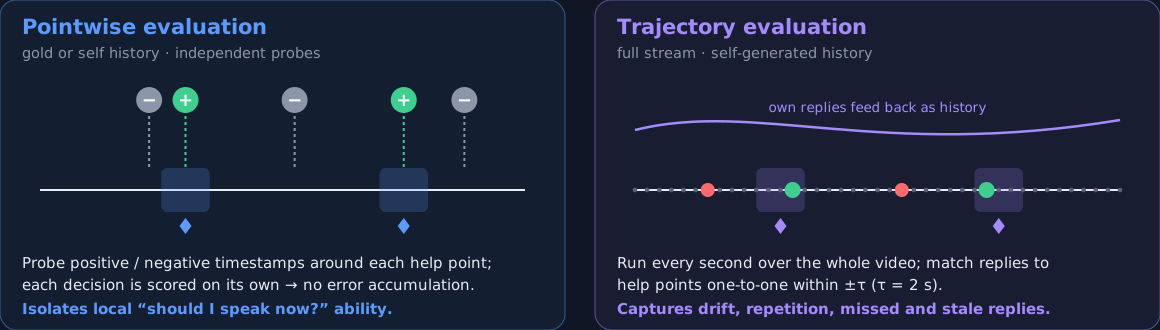
600 explicit · 2,000 implicit · 1,500 dynamic samples. Scored on timing (P / R / F1 / FPR) and quality (answer score, content F1).
| Benchmark | User intent type | Dur. (min) | Evid. | Environment | Eval setting | Traj. | ||||
|---|---|---|---|---|---|---|---|---|---|---|
| Explicit | Implicit | Dynamic | Physical | Digital | Pointwise | Trajectory | ||||
| ProactiveVideoQA | ● | ○ | ○ | 2.1 | 3.5K | ● | ○ | ○ | ● | 1.4K |
| EgoProactive | ◐ | ● | ○ | 3.5 | 5.4K | ● | ○ | ● | ○ | 700 |
| EgoPro-Bench | ● | ● | ○ | 3.0 | 2.4K | ● | ○ | ○ | ● | 2.4K |
| IPIBench | ● | ○ | ● | 1.0 | 3.7K | ● | ○ | ● | ◐ | 1.8K |
| EgoServe | ◐ | ● | ◐ | 6.2 | 3.4K | ● | ○ | ○ | ● | 293 |
| GuideMe | ● | ● | ○ | 5.5 | 47.8K | ● | ○ | ● | ◐ | 2.5K |
| GUIDE | ● | ● | ◐ | 33.8 | 0.7K | ○ | ● | ● | ○ | 120 |
| StreamVibe-Bench (ours) | ● | ● | ● | 8.3 | 20.5K | ● | ● | ● | ● | 4.1K |
● full ◐ partial ○ no support. Dur.: average sample duration; Evid./Traj.: numbers of evidence points and evaluation trajectories.
StreamVibe-VL and StreamVibe-Harness
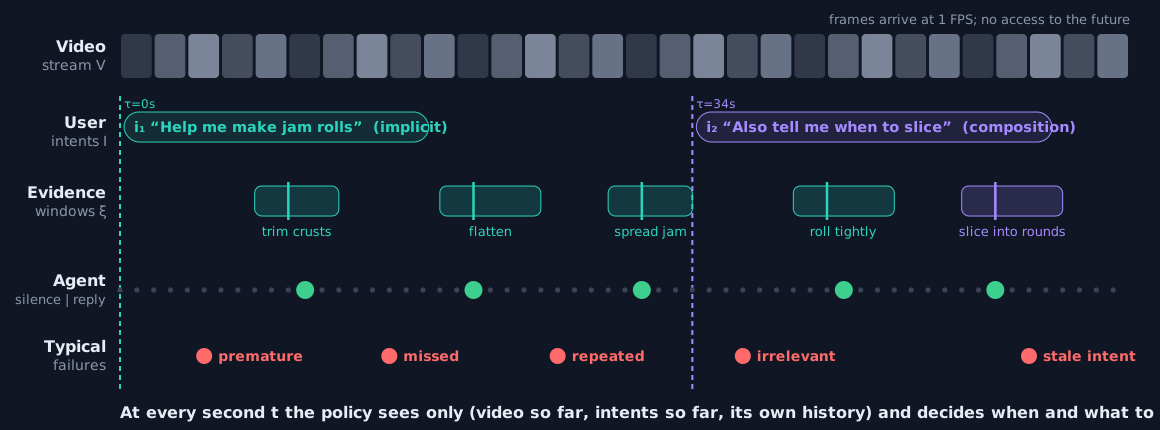
A streaming model decides when and what to say; a harness keeps track of the requests.
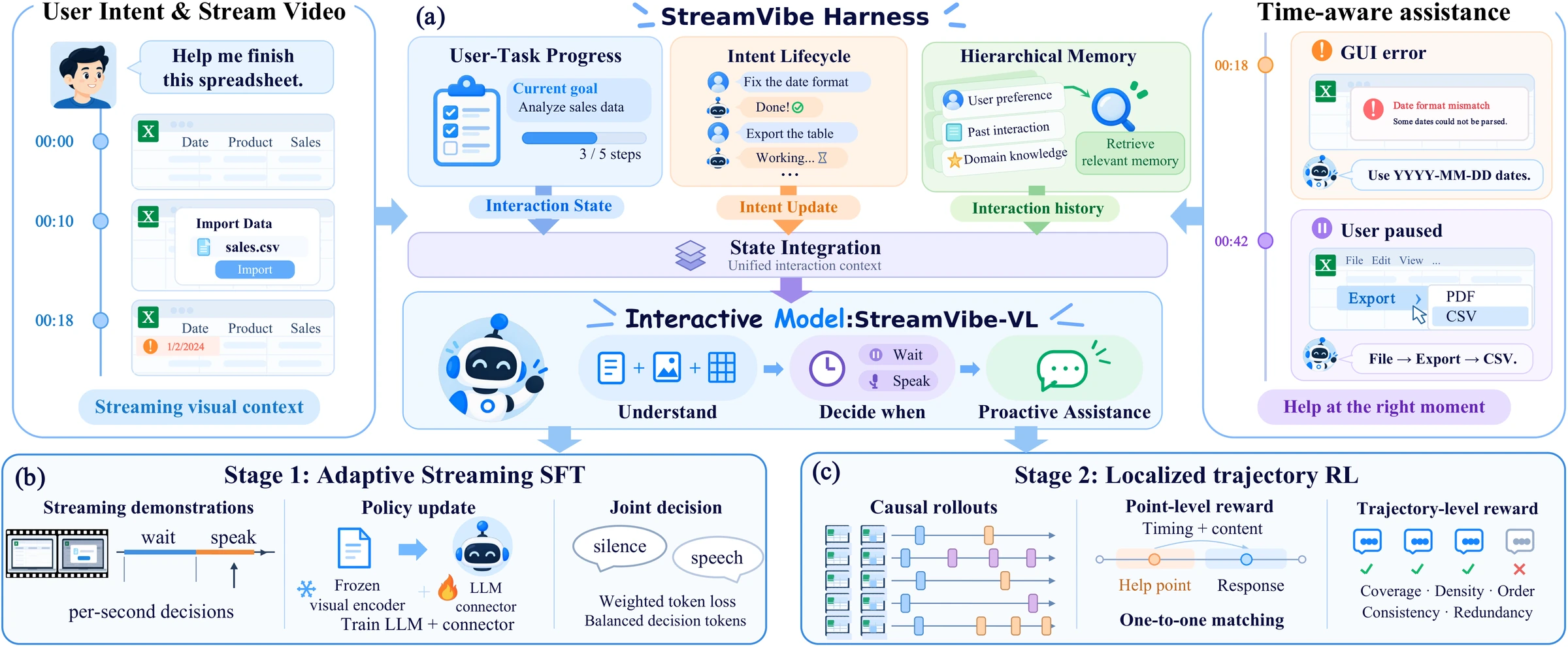
HStreamVibe-Harness
Tracks every request, task progress and past replies; retrieves the relevant history.
1Adaptive streaming SFT
Balances silence and response so the model neither stays mute nor over-talks.
70K + 768K samples
2Localized trajectory RL
GRPO on short rollouts around help points, rewarding timing, content and consistency.
15K tasks
Results
Against 11 proprietary, offline and streaming models.
Content F1 on StreamVibe-Bench
vs. the best open-source baseline
Other proactive benchmarks
EgoProactive and IPIBench
General video understanding
accuracy before → after training
@article{liu2026streamvibe,
  title   = {StreamVibe: Proactive Video Agents for Evolving User Intent},
  author  = {Liu, Chengzhi and Lai, Yuxiang and Yang, Yuzhe and Liu, Yanqing and
             Hou, Jiheng and Cao, Yue and Wang, Haonan and Fan, Ruixi and
             Wang, Lan and Liu, Sheng and Peng, Songyou and Song, Yale and
             Lin, Kevin Qinghong and Wang, Xin Eric and Lai, Jui-Hsin and Tang, Youbao},
  year    = {2026}
}